Fill Tool
You can use the Fill tool in the Tool palette to fill an area surrounded by lines or an area already painted with a single color. Select the color you want to fill, and then the layer you want to fill in from the Layer palette. You can also fill using Edit > Fill.
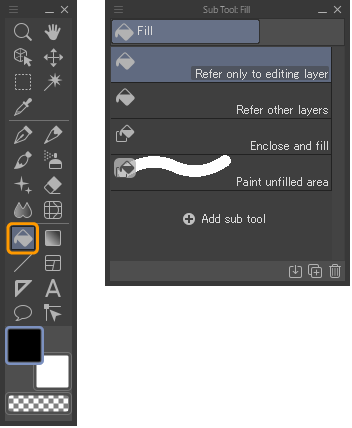
The Fill tool has a variety of settings to fill an image. The fill color will be the current drawing color. For information on changing the drawing color, see "Selecting colors".
Memo | If Fill is taking a long time to process, you can cancel it by pressing ESC. |
There are five default tools for filling. The Tool Settings palette and Advanced Tool Settings palette allow you to make more detailed settings, such as which layers to refer to when filling, or to close gaps between lines when filling.
Refer only to editing layer
Use the Fill tool > Refer only to editing layer to fill based only on the content of the selected layer. Settings to refer to other layers are turned off by default.
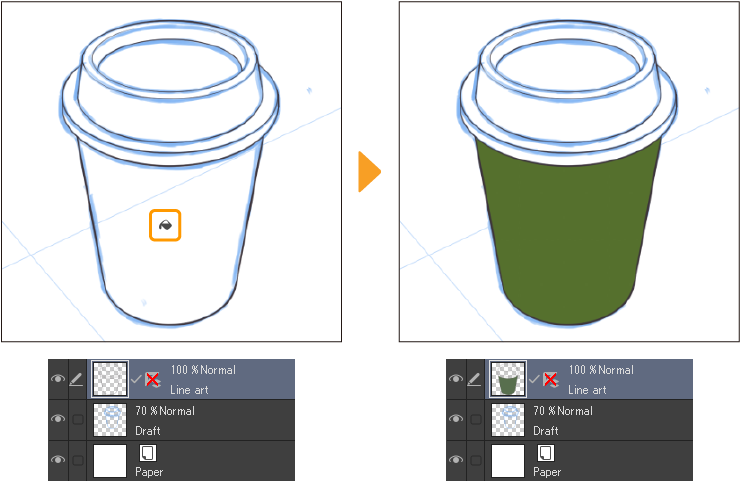
Drag to fill multiple adjoining closed areas at once.
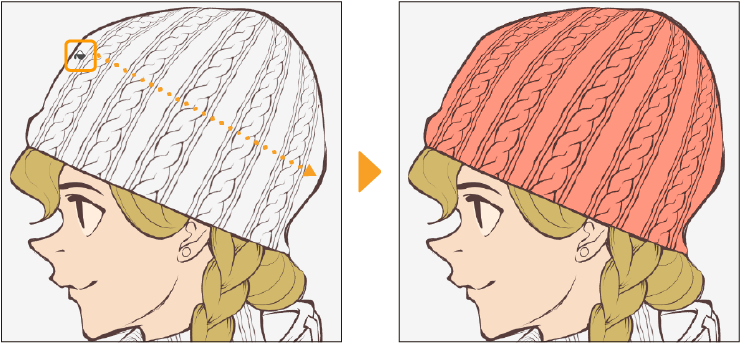
The Tool Settings palette and Advanced Tool Settings palette allow you to make more detailed settings, such as which layers to refer to when filling, or to close gaps between lines when filling. In the Advanced Tool Settings palette, you can adjust the Refer only to editing layer tool with these settings: "Fill", "Reference", "Ink", "Adjust parts".
Refer other layers
With the Fill tool > Refer other layers, you can fill on one layer while referring to other layers in your project. You can use this to keep your lineart and color layers separate.

The Tool Settings palette and Advanced Tool Settings palette allow you to make more detailed settings, such as which layers to refer to when filling, or to close gaps between lines when filling. In the Advanced Tool Settings palette, you can adjust the Refer other layers tool with these settings: "Fill", "Reference", "Ink", "Adjust parts".
Enclose and fill
Use the Fill tool > Enclose and fill to encircle a closed area that you want to fill. You can use this to fill complex shapes and shapes with a lot of closed areas in one go.
By default, this tool refers to all layers in the project.
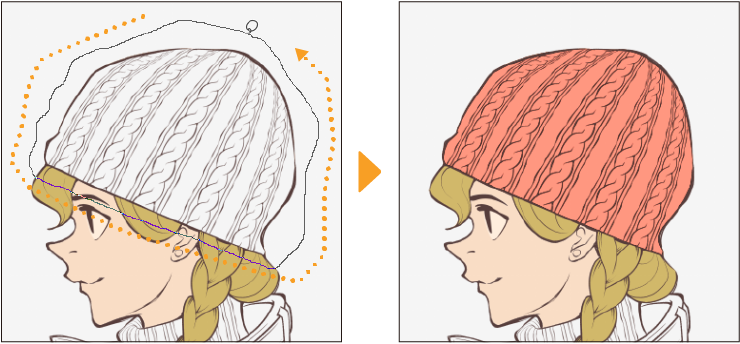
The Tool Settings palette and Advanced Tool Settings palette allow you to make more detailed settings, such as which layers to refer to when filling, or to close gaps between lines when filling. In the Advanced Tool Settings palette, you can adjust the Enclose and fill tool with these settings: "Fill", "Reference", "Lasso", "Ink", "Adjust parts", "Correction".
Lasso fill
Use the Fill tool > Lasso fill to define an area by dragging and fill the lassoed shape with the selected color. You can use this to fill a custom area with a flat color, such as for shading or color blocking.
You can also combine Lasso Fill with selection areas to fill a specific area within a selection, like the following example.
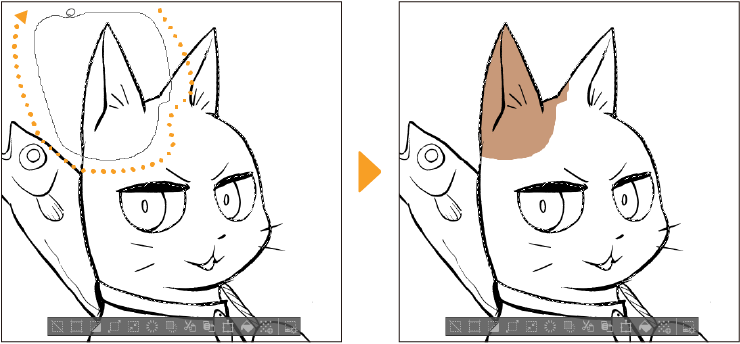
The Tool Settings palette and Advanced Tool Settings palette allow you to make more detailed settings, such as which layers to refer to when filling, or to close gaps between lines when filling. In the Advanced Tool Settings palette, you can adjust the Lasso fill tool with these settings: "Fill", "Reference", "Ink", "Adjust parts".
Leftover pen
Use the Fill tool > Leftover pen by dragging the tool over an area to fill closed spots in the area. This tool is perfect for coloring areas that are very small and difficult to fill, such as the tips of hair, or 1-pixel lines.
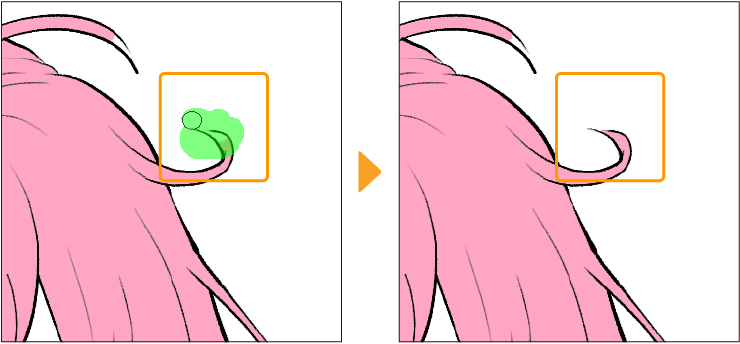
The Tool Settings palette and Advanced Tool Settings palette allow you to make more detailed settings, such as which layers to refer to when filling, or to close gaps between lines when filling. In the Advanced Tool Settings palette, you can adjust the Leftover pen tool with these settings: "Fill", "Reference".